
Sega was started back in 1940 in Honolulu Hawaii by Martin Bromely, Irving Bromberg, and James Humpert. Originally Sega was known as Standard Games and they created, designed and provided coin-operated amusement and games for the American military on bases around the world.
Due to Hawaiis close proximity with Japan,Martin Bromley suggested that Standard Games be moved to Japan. Japan was at the time a booming country due to the recovery after WWII. Investors wanted to get in the rebuilding of Japan and the amount of American and allied military presence in Japan at the time made a lot of business sense. This way Standard Games would be able to provide coin-operated amusements for more military personnel without having to ship items all over. It would be a close grouping of military customers.
So in 1951 Standard Games moved from Honolulu to Tokyo, Japan. After the move Standard Games changed their name to Service Games of Japan. The name change isnt 100% known for sure, but most assume it was due to the Servicemen and Women who the coin-operated games were designed to entertain. You can clearly see where the Sega name comes from. The first 2 letters from Service and the first 2 letters from Games spell SEGA.
Another American played a huge role in the history of Sega. His name was David Rosen. Rosen, who was an avid art enthusiast of Asian styles, visited Tokyo and eventually moved there due to his overwhelming love for the booming Asian city. In 1954 Rosen established Rosen Enterprises in Tokyo. He specialized in exporting Japanese and Asian art to the western market. Rosen started to import items from the west into Japan and started to import a line of coin-operated photo booths. These were almost an instant success! The Japanese loved these instant photo booths and Rosen had a huge hit on his hands.
David Rosen sometime in the early 80s
Rosen seeing the potential of coin-operated amusements in Japan started to import other different coin-operated electro-mechanical games. Rosen was well aware of his competitors in Service Games of Japan and for a few years they fought for the same share of coin-operated amusement territory. Eventually Rosen and the group from Service Games of Japan merged in 1965. Together they created Sega Enterprises. This is the first real time that the Sega name was used.
By 1966 Sega Enterprises was in full swing working hard to come out with new and exciting coin-operated amusements for the emerging Japanese market. Their first real smash hit as Sega Enterprises was with the submarine simulator called Periscope. Almost instantly it became a huge seller. It was very popular and sold all over the world.
Advertising Flyer for Sega’s Periscope Smash Hit
Sega Enterprises would be changed again. In 1969 Gulf Western acquired Sega Enterprises and made it into a division of Gulf Western. Rosen was kept on as the CEO of the Sega division of Gulf Western. Even with a larger company looming over its shoulders, Rosen was still able to control Sega as he felt was right. Doing so allowed Rosen to keep Sega prosperous and able to expand its market share worldwide.
As time went on Sega changed from electro-mechanical to arcade video games. Some of their early mega successful arcade games included Zaxxon and Out Run. These games were ported over the years in many different forms onto many different home consoles, covering everything from Commodore 64 to the Dreamcast and many in between. Zaxxon and Out Run were so popular you can see how many games of todays generation are still using the basic ideas that these games brought out in the 1980s.
Original Zaxxon and Out Run Arcade Cabinets Produced By Sega in the Early 1980s
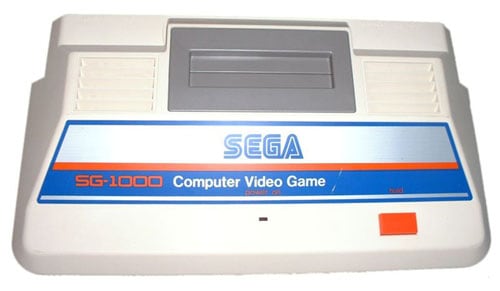
Bringing out constantly loved and acclaimed titles Segas profits soared to over $210 Million between 1982 and 1983. During this time Sega was also in development of its first ever video game console called the SG-1000. That wasnt enough for Sega though. They also were bringing out new arcade games at the time and also started the short lived trend with Astron Belt which was the first ever arcade game to use laser disc technology in an arcade cabinet.

Sega’s First Venture Into the Home Console Market the Sega SG-1000
Astron Belt Was the First Arcade to Use Laser Disc Technology
Sega, even though in a large profit margin at the time, didnt expect the American video game crash to hit. In 1983 arcades all over America dried up. Sega was still throwing money into their development of new and exciting games, but no matter how hard they tried nobody was out there to play them. Losing money hand over fist Gulf Western sold Segas US assets to the very well known pinball and alternate amusement company Bally. Segas Japanese assets were sold to a group of investors brought together by Rosen and Hayao Nakayama.
Hayao Nakayama didnt have any real interest in video games or Sega. Rosen was just a good salesman. He convinced Nakayama that this video game recession was going to be short lived. Rosen knew Nakayama because Rosen purchased Nakayamas former distribution company in 1979. With Rosen and Nakayama on board the other investors quickly followed suit and Segas Japanese assets were now back in Rosens hands.
Nakayama knowing Japanese better than Rosen took lead of Sega of Japan and was situated as their CEO. Rosen on the other hand took his place as Sega of Americas head in the United States. With Nakayama and Rosen at the head of the ship Sega had some of the best business mind working on its side.
Sega CEO Hayao Nakayama. That Hair Aint Fooling Anyone.
1984 was the year Rosen and Nakayamas effort paid off. CSK stepped up to the plate and bought Sega and renamed it Sega Enterprises Ltd. CSK is a holdings company that mostly provides IT support and other services to many different companies worldwide. When CSK bought Sega they headquartered it in Japan, again. CSK did some amazing things with Sega and within only 2 years of being a CSK company Sega had stocks traded on the Tokyo Stock Exchange. Rosens personal friend and chairman of CSK, Isao Okawa became the chairman of Sega soon after.
In 1985 Nintendo released the Nintendo Entertainment System in America starting resurgence in the video game market in the United States. Sega knew that they needed to act fast to take advantage of this situation. In September 1986 Sega released the Sega Master System to the North American market.

First Version of the Sega Master System
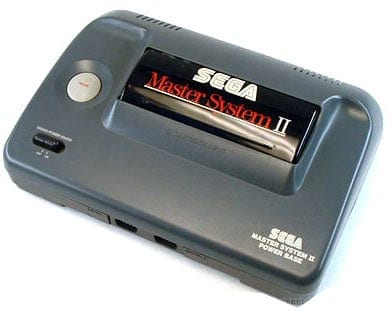
Second Version of the Sega Master System
The Sega Master System was released with one game emulating the release idea of Nintendo at the time. Superior in performance and ability the Master System did poorly in comparison to the NES. The reason for this is that Tonka, the company who had the distribution rights to the Sega Master System, under the Sega name, did a very poor job at advertising the system to its primary market. Also Nintendos aggressive advertising campaign during the same time made many people unaware of the Master Systems even existence.
Sega didnt get discouraged by the North American console sales numbers and still pushed the sale of it in Europe and Brazil. It was also released in the Japanese market, but Nintendo also already had the market mostly covered there. Nintendos lack of comparable advertising in Europe and Brazil allowed the Master System to thrive in those markets where the NES did not do as well. It was so popular that Sega still continued to make Master System consoles for sale in Europe until 1996 and in Brazil until 2000! Almost unheard of by todays standard, a system being produced for over 12 years!
In August of 1989 Sega released its next generation console, the Sega Genesis / Sega Mega Drive. The Genesis name was used in North America and Mega Drive was used in Europe and Japan. Sega released this console so early because they wanted to beat Nintendo to the line with their new and upcoming system the Super Nintendo Entertainment system. They did by just shy of 2 years.
The Three Versions of the Sega Genesis / Mega Drive Console
Just before the launch of the SNES, Sega decided that their consoles mascot, Alex Kidd, wasnt as fresh and exciting as their new console was. It was time for something new and different, a mascot with attitude. Sonic was born soon afterwards. Instead of now just being another video game console it was the baddest (in a good way) console out there. Sonic was marketed to the public as the coolest video game character of all time. Sonic was so much cooler than Mario of Nintendo and made it known in many of its commercials and advertisements.
Alex Kidd on the Left and Sonic the Hedgehog on the Right. Sega Made a Smart Choice
Sonics release, system branding, and aggressive marketing skills brought Sega up to 65% of the North American market share for video game consoles for a short period of time. Not waiting to cool down after the SNES was launched Sega released the Sega CD in 1992. Allowing users to attach the Sega CD to their existing Sega Genesis / Mega Drive systems there was no need for another console to play these new and improved games on.
Sega CD 1 on the Left and Sega CD 2 on the Right
The Sega CD was something that North American gamers had never seen before. It allowed more information to be packed into each game due to the CD ROM format of the discs. More information meant better graphics, more stories, longer game play and thus more fun in theory. Of course the most popular game on the Sega CD was a Sonic title called Sonic CD. Sega wasnt done there. They wanted to keep showing the public that they were the most ingenious video game company on the market and this is when in 1994 they released the Sega 32X.
The 32X was a console adaptation much like the Sega CD. All you needed was your existing Sega Genesis / Mega Drive console and you could play the 32X. Just plug it in the top of the Genesis / Mega Drive and you could boost the 16bit graphics of the system to a whopping 32 bits of glory. The Sega 32X sold very well initially, but due to lackluster game titles available for it and the upcoming release of other video game systems by companies like Sony, Segas own Saturn console and Nintendos Ultra 64 (later to be renamed the Nintendo 64) the 32X was an ultimate failure.
Sega 32X and It Sucked!
Things didnt get much better for Sega from here on out in the home market. Even with the success of the Genesis / Mega Drive, Segas aggressive marketing tactics, poor build quality and attempts to milk the consumer for all their money, Segas fans started to slowly go to other consoles.
Sega still pushed forward however, especially in the arcades. In 1993 Sega released an instant success called Virtua Fighter. Arcade halls were packed again with gamers wanting to play this new and amazing 3D fighter. The new design of the Sega Model 1 arcade cabinet allowed graphics and game play that the world had never seen in an arcade before. Virtua Fighter defined the 3D fighting genre forever. Sega also released the amazingly popular 3D racing game Daytona USA. The most profitable racing arcade series of all time Daytona USA gave video game race fans something new and exciting that they had never seen.
Sega Smash Hits: Virtua Fighter and Daytona USA
Sega trying to recover from poor sales and dropping market share during this period in the home market released the Sega Channel. The Sega Channel allowed a video game service through a customers local cable television provider. For a subscription price and a special adapter cartridge customers were able to play games from a large database without actually having to buy the cartridge. With over 250,000 subscribers at its peak the Sega Channel would prove to be well ahead of its time, paving the way for online games of this generation.
The Sega Channel Adapter
Trying to capitalize on their arcade success the Sega Saturn was released in 1995 in North America. Sega wanted to allow the public to play their favorite Sega arcade titles at home and hope that the Saturn having exclusive rights to many of these titles would bring Sega back into a contender position in the home gaming market. However this never happened. Sega failed to meet their goals and within 3 years the Saturn was discontinued in the North American market.
Sega Saturn Console
Down but not out, Sega told many investors and the public that they didnt stop making the Saturn due to sales numbers, but Sega wanted to focus on the next generation system instead, the Sega Dreamcast.
In 1999 Sega released the Sega Dreamcast. With amazing graphics, online capability, CD format, unique design, technology, and great title selection the Dreamcast was placed to be a very serious contender in the home console market. Finally Sega was in a place where it needed to be. With amazing games, amazing graphics and now a strong following again Sega was headed for glory, except for a few minor problems.

Sega Dreamcast Console
The Dreamcast did very poorly at launch in Japan. This was due to its poor launch titles of games that nobody really cared about. However the Dreamcast sold very well in the west with over 500,000 copies in its first week! Sega was doing great in the North American market until the launch of the Sony PS2. Due to the amount of PS1 fans Sony had a dedicated fan base just waiting for the PS2 to release. When this happened the Dreamcast wasnt nearly as successful. Even with new and innovative titles being released for it the Dreamcast couldnt catch up enough momentum to compete with the PS2, Game Cube or XBOX. Sega officially stopped making the Dreamcast in 2002. Also the large amount of game piracy due to the ease of copying and reproducing Dreamcast games was the final straw for Sega.
Sega today makes software for other consoles and is having great success at it. With all their old characters like Sonic appearing on Nintendo, Sony and Microsoft consoles, something 10 years ago we would have never guessed, Sega continues to push the envelope with innovation and creativity. Rumors are always floating around saying that Sega would be back with another console, but nobody knows for sure. Either way Sega has been a huge influence to the video game genre for the last 70 years. So you Nintendo fan boys need to show some respect where it’s due!
– Mike From The Internet
